
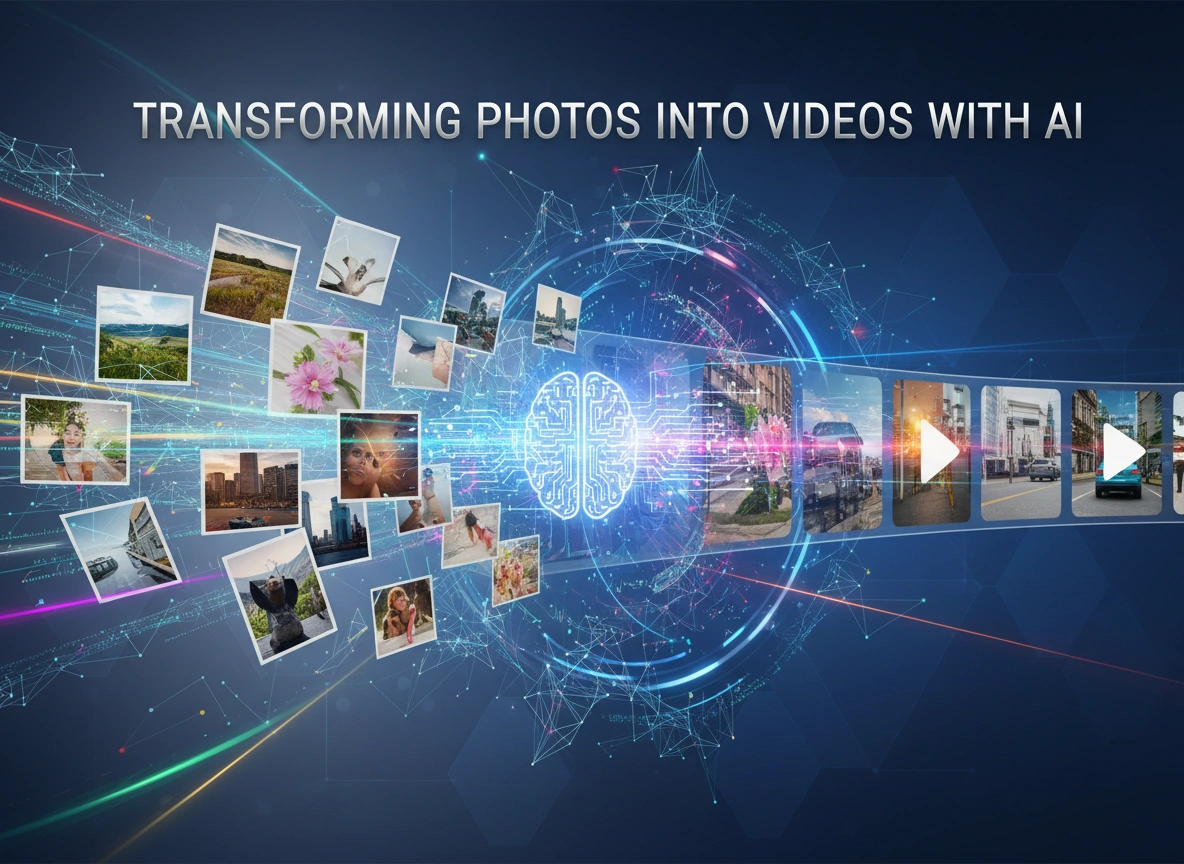
A single picture can tell a story, but what if you could make that story move? Artificial intelligence is now making it possible to breathe life into static images, transforming them into dynamic, engaging videos. This technological leap is not just a novelty; it represents a significant shift in how we create and consume content. From marketing to historical preservation, the ability to animate photos with AI is opening up a new frontier of digital storytelling.
This article explores the technology behind photo-to-video AI. We will examine the benefits of this transformation and its diverse applications across various industries. We will also look at the specific tools making this possible, the technical processes at work, and the future potential of this exciting field.
The Rise of AI in Visual Content Creation
Visual content has long been a cornerstone of digital communication, but video consistently drives higher engagement than static images. Creating high-quality video, however, has traditionally been resource-intensive, requiring time, skill, and expensive equipment. AI is changing this equation by democratizing video production.
AI-powered tools can now analyze a still photograph and generate new frames to create the illusion of motion. This process, which once required skilled animators, can now be accomplished in minutes. The results are often startlingly realistic, turning a simple portrait into a person who blinks and smiles, or a landscape photo into a scene with flowing water and rustling leaves. This advancement is a game-changer for content creators, marketers, and anyone looking to tell a more compelling visual story.
How AI Transforms Photos into Videos: The Technology Explained
The magic of turning a photo into a video relies on several complex AI and machine learning models working in concert. These technologies analyze the content of an image and intelligently predict how it would move in a three-dimensional space. Let’s break down the core technical aspects.
Motion Interpolation and Frame Generation
At its heart, video is a sequence of still images (frames) displayed rapidly. To create a video from a single photo, AI must generate the frames that would exist between a hypothetical start and end point. This is known as motion interpolation or “in-betweening.”
AI models are trained on vast datasets of videos to understand how objects and people naturally move. When given a photo, the AI identifies different elements—a person, a tree, clouds—and applies learned motion patterns. For example, it knows that a person’s head can tilt slightly, eyes can blink, and a subtle smile can form. It then generates the intermediate frames needed to create this smooth animation.
Image Synthesis and Generative Adversarial Networks (GANs)
To make the animation believable, the AI must do more than just move pixels around. It needs to synthesize, or create, new visual information that wasn’t in the original photo. This is where technologies like Generative Adversarial Networks (GANs) come into play.
A GAN consists of two neural networks: a Generator and a Discriminator. The Generator creates the new image frames, while the Discriminator evaluates them for realism by comparing them to real video frames from its training data. The two networks essentially compete, with the Generator constantly trying to fool the Discriminator. This process results in highly realistic generated frames where, for instance, a person’s teeth are revealed as they smile, even if they weren’t visible in the original static photo.
3D Depth Mapping and Parallax Effect
To create a sense of depth and dimensionality, many AI tools employ 3D depth mapping. The AI analyzes the photo to estimate the distance of various objects from the camera. It identifies the foreground, midground, and background elements.
Once this depth map is created, the AI can simulate camera movement, creating a subtle panning or zooming effect known as parallax. The foreground elements move faster than the background elements, which mimics how our eyes perceive depth in the real world. This technique can turn a flat landscape photograph into an immersive, three-dimensional scene, adding a professional, cinematic quality to the final video.
Applications Across Industries
The ability to animate photos with AI is not just a technical curiosity; it has practical and powerful applications. Industries are quickly adopting this technology to enhance their content, engage audiences, and create new experiences.
Marketing and Advertising
In marketing, grabbing attention is everything. AI-animated photos provide a novel way to make advertisements more dynamic and memorable. Brands can repurpose their existing library of high-quality photographs, turning them into short, engaging video ads for social media platforms like Instagram, TikTok, and Facebook. This is far more cost-effective than producing a full-scale video shoot. For example, a fashion brand could animate a model’s photo to show a subtle sway in the fabric of a dress, making it feel more tangible and appealing.
Education and Historical Preservation
History can feel distant and static when viewed through old, black-and-white photographs. AI animation is changing that. Historians and educational institutions are using these tools to bring historical figures to life. Seeing a figure like Abraham Lincoln or Marie Curie blink and subtly shift their gaze creates a powerful, humanizing connection that a static image cannot replicate. Genealogy platforms have integrated this feature, allowing users to see their ancestors’ faces move for the first time, creating a deeply personal and emotional experience.
Entertainment and Social Media
On social media, trends move quickly. AI photo animation has already become a viral phenomenon, with users animating everything from old family photos to internet memes. This form of user-generated content is highly shareable and drives significant engagement. In the entertainment industry, filmmakers and game developers can use this technology for pre-visualization, creating animated storyboards from concept art to better plan their shots and sequences.
Leading Tools and Platforms in AI Photo Animation
Several platforms have emerged as leaders in the photo-to-video AI space. Each offers a unique set of features tailored to different users, from casual social media enthusiasts to professional content creators.
- Runway Gen-2: A powerful, multi-modal AI system, Runway is at the forefront of generative video. Its text-to-video and image-to-video capabilities allow creators to generate entire video clips from a single image prompt, offering extensive creative control.
- Pika: Pika is another prominent tool that excels at transforming images and text into video. It gives users fine-grained control over aspects like camera motion and subject movement, making it popular for creating specific, stylized animations.
- MyHeritage: This genealogy platform gained widespread attention for its “Deep Nostalgia” feature. Built on technology licensed from D-ID, it specializes in animating faces in old photographs, allowing users to see their ancestors in a new light.
- D-ID (Creative Reality™ Studio): D-ID provides a platform for professionals to create videos featuring talking avatars from a single image. Users can upload a photo, type a script, and the AI generates a video of the person speaking the words with realistic lip-syncing and facial expressions. This is particularly useful for corporate training, digital assistants, and educational content.
Ethical Considerations and Future Potential
As with any powerful AI technology, photo animation raises important ethical questions. The potential for misuse, such as creating deepfakes for malicious purposes, is a significant concern. Creating realistic but fabricated videos of individuals without their consent could be used for misinformation or harassment. As a result, many platforms are implementing safeguards, such as watermarks on AI-generated content and restrictions on animating photos of public figures.
Looking ahead, the future of this technology is incredibly bright. We can expect AI models to become even more sophisticated, enabling longer and more complex video generation from a single image. Future advancements may include:
- Full-body animation: Moving beyond subtle facial movements to generate realistic full-body motion.
- Interactive environments: Creating videos where users can interact with the animated scene.
- Audio integration: Automatically generating appropriate sound effects or ambient noise to match the animated video.
This technology is poised to further blur the lines between photography and videography, empowering creators with tools that were once the exclusive domain of visual effects studios.
Conclusion: A New Era of Visual Storytelling
Transforming photos into videos with AI is more than just a passing trend. It represents a fundamental evolution in content creation. By leveraging sophisticated techniques like motion interpolation and generative AI, these tools are making video production more accessible, affordable, and imaginative.
From bringing historical photos to life to creating captivating marketing content, the applications are vast and growing. While it is crucial to navigate the ethical landscape responsibly, the potential for positive impact is immense. This technology empowers us to unlock the hidden dynamism within every photograph, ushering in a new era of compelling and immersive visual storytelling.
Please visit this website for more info
