
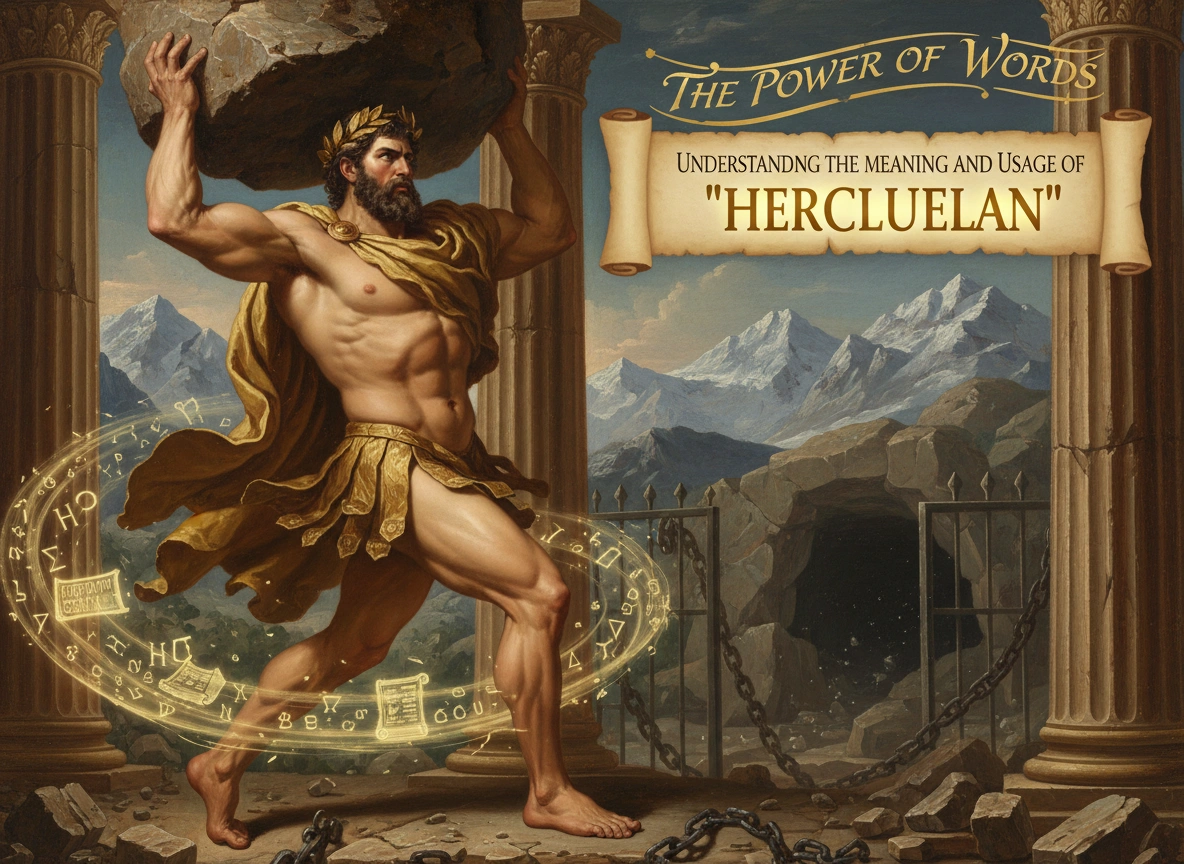
Language is not merely a tool for communication; it is an archive of human history, a repository where myths, legends, and ancient cultures continue to breathe. Certain words carry a weight far greater than their dictionary definitions. They bring with them the echoes of heroes, monsters, and divine trials. One such word, powerful and enduring, is “Herculean.”
To describe a task as Herculean is to do more than say it is difficult. It is to invoke a specific kind of enormity—a challenge that borders on the impossible, requiring strength of character and body that surpasses the ordinary. This article explores the rich tapestry behind this potent adjective, tracing its journey from ancient Greek mythology to modern boardrooms, and examining why it remains one of the most evocative descriptors in the English language.
mythological Roots: The Man Behind the Adjective
To understand the word, we must first understand the man—or rather, the demigod—who gave it his name. Hercules (known as Heracles in the original Greek) is perhaps the most famous figure in classical mythology. Born of Zeus, the king of the gods, and Alcmene, a mortal woman, Hercules was endowed with supernatural strength from birth. However, his life was not one of ease. It was defined by struggle, primarily due to the wrath of Hera, Zeus’s wife, who despised him as a living reminder of her husband’s infidelity.
The etymology of the word “Herculean” is directly tethered to the “Twelve Labors of Hercules.” These were a series of penances Hercules was forced to undertake to purify himself after a fit of madness induced by Hera led him to tragedy. These labors were designed to be impossible. They included slaying the Nemean Lion, whose hide was impenetrable; cleaning the Augean stables, which housed thousands of cattle and had not been cleaned in thirty years, in a single day; and capturing Cerberus, the three-headed guardian dog of the Underworld, with his bare hands.
When we use the word “Herculean” today, we are referencing this specific scale of effort. We are not talking about a hard day at the office or a tricky crossword puzzle. We are invoking the energy required to hold up the sky (another of his feats) or slay a multi-headed Hydra. The word carries the DNA of divine struggle and the triumph of will over insurmountable odds.
The Evolution into Modern Language
The transition of “Herculean” from a proper noun referencing a specific individual to a common adjective occurred over centuries. By the late 16th and early 17th centuries, English writers began adopting the term to describe any labor that required extraordinary exertion.
It is a testament to the power of the myth that the word survived the fall of the civilizations that created it. While we no longer worship Zeus or build temples to Hera, the adjective remains a staple of our vocabulary. It has evolved to encompass two distinct but related meanings:
- Possessing great strength or size: This usage refers directly to the physical attributes of the hero. A bodybuilder might be described as having a “Herculean physique.”
- Requiring extraordinary effort: This is the more common usage, referring to tasks or challenges. A “Herculean effort” is one that demands every ounce of capability a person or organization possesses.
This evolution highlights how language preserves the essence of a story even when the details fade from popular memory. You do not need to know the specific details of how Hercules stole the Golden Apples of the Hesperides to understand that a “Herculean task” is one that is likely to break you.
Herculean in Literature and Rhetoric
Writers have long relied on “Herculean” to add gravity to their prose. It serves as a shorthand for epic struggle. In literature, it elevates a character’s conflict. When an author describes a protagonist’s journey as Herculean, they immediately signal to the reader that the stakes are high and the odds are long.
Consider Shakespeare, who frequently drew upon classical mythology. In Antony and Cleopatra, Antony is compared to his ancestor Hercules, using the association to highlight his immense, tragic stature. In more modern literature, the term is often used metaphorically. A character might face a “Herculean struggle against addiction” or a “Herculean effort to rebuild a shattered life.”
In rhetoric and speechwriting, the word is a favorite for rallying cries. Politicians often describe the road to recovery after a crisis as a “Herculean task,” framing the situation not just as difficult, but as a heroic narrative where the citizens are the heroes overcoming the odds. It transforms suffering into a noble endeavor.
The Word at Work: Business and Professional Contexts
In the corporate world, hyperbole is common, but “Herculean” retains a specific utility. It is used to describe projects that are massive in scope, tight on deadlines, or fraught with technical complexity.
For example, a merger between two multinational corporations might be described as involving a “Herculean integration process.” This signals to shareholders and employees that the road ahead involves merging distinct cultures, disparate IT systems, and thousands of employees—a task akin to cleaning the Augean stables.
Similarly, in the startup ecosystem, founders often speak of the “Herculean effort” required to reach profitability or secure a specific round of funding. Here, the word conveys resilience. It suggests that while the challenge is immense, the team has the grit required to succeed. It distinguishes the mundane “hard work” of daily operations from the “sprint” or “pivot” that defines the company’s survival.
However, a word of caution is necessary for business writers. Overusing powerful words dilutes them. If every quarterly report describes a minor sales bump as a “Herculean victory,” the word loses its edge. It should be reserved for the truly exceptional—the turnaround of a failing legacy brand, the launch of a revolutionary product, or the navigation of a global supply chain crisis.
Everyday Usage and Cultural Significance
Outside of books and boardrooms, “Herculean” has found a comfortable home in everyday speech, particularly in sports journalism and commentary. An athlete who plays through an injury to win a championship is often lauded for their “Herculean performance.” A tennis match that lasts five hours or a marathon run in extreme heat fits the mold perfectly. In this context, it celebrates the limits of human physical potential.
We also see it in social commentary. We might speak of the “Herculean patience” required to deal with bureaucracy, or the “Herculean logistics” involved in organizing a massive event like the Olympics or a global vaccination drive.
Why do we cling to this word? Because humans love to narrativize their lives. We want to believe that our struggles have meaning. By applying a word rooted in the story of a demigod to our own challenges, we elevate our experiences. We are not just struggling; we are battling monsters. We are not just tired; we are enduring labors.
The Nuance of “Herculean” vs. “Hard”
It is worth exploring why a writer would choose “Herculean” over simpler synonyms like “hard,” “difficult,” or “strenuous.”
“Hard” is neutral. A math problem is hard. A concrete floor is hard. It describes the state of the object or task, but it says nothing about the person engaging with it.
“Strenuous” implies physical exertion and sweat, but it lacks grandeur. A workout is strenuous, but it is rarely epic.
“Herculean,” however, implies a dynamic relationship between the challenger and the challenge. It suggests that the task is so great that it defines the person undertaking it. It implies that failure is a distinct possibility, making success all the more glorious. It also carries a connotation of scale. You cannot have a “Herculean” problem that is solved in five minutes. It implies duration, persistence, and magnitude.
Conclusion: The Enduring Strength of a Word
The English language is vast, comprising hundreds of thousands of words, yet we often return to the classics to express our most profound experiences. “Herculean” is a prime example of linguistic endurance. It has survived for thousands of years, traveling from the oral traditions of ancient Greece to the digital screens of the 21st century.
Its power lies in its ability to capture a specific human experience: the confrontation with the overwhelming. Whether used to describe a physical feat, a mental struggle, or an organizational challenge, it honors the effort involved. It reminds us that while we may not be demigods, we are capable of extraordinary things.
As we continue to face global challenges—climate change, pandemics, social inequality—we will undoubtedly continue to reach for this word. These are Herculean problems, requiring Herculean solutions. By understanding the roots and the weight of the word, we can use it not just as a descriptor, but as a call to action—a reminder that even the impossible labors can, eventually, be completed.Please click here for more info.
You may also read: Exploring Moral Dilemmas: Real-Life Examples and How to Navigate Them
