
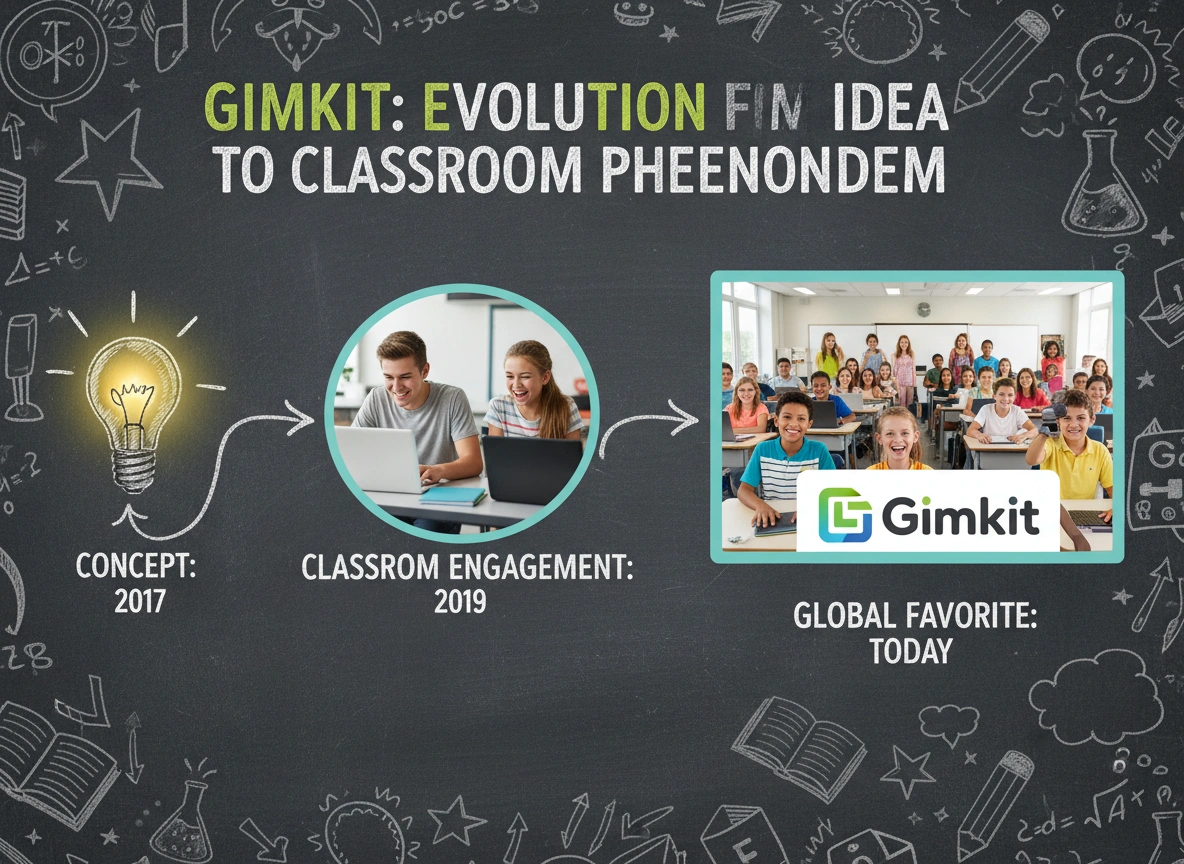
The modern classroom often feels like a battleground for attention. Teachers compete with smartphones, daydreams, and the general restlessness of youth. In this landscape, gamified learning platforms have emerged not just as a novelty, but as essential tools for engagement. Among these, Gimkit stands out as a unique success story—a platform built not by a corporate giant or a seasoned educational theorist, but by a high school student who simply wanted a better way to study.
This article explores the remarkable journey of Gimkit, tracing its path from a student’s frustrated brainstorm to a staple in classrooms worldwide. We will examine the mechanics that make it addictive (in a good way), the challenges it overcame, and its lasting impact on educational technology.
The Spark: A Student Solving a Student’s Problem
Most educational tools are built top-down. Administrators or developers decide what students need and build it. Gimkit flipped this script entirely. Its story begins in 2017 with Josh Feinsilber, a high school junior in Seattle, Washington. Like many students, Feinsilber was subjected to endless rounds of existing review games like Kahoot! and Quizlet Live. While these tools were fun, he felt something was missing. The engagement often dropped off once students fell behind on the leaderboard, and the mechanics felt repetitive after the tenth game of the semester.
Feinsilber had a background in coding and a simple hypothesis: a game would be more engaging if it borrowed mechanics from modern video games, specifically the concept of earning currency and purchasing upgrades. He wasn’t trying to revolutionize education initially; he just wanted to build a project for himself.
The first version was rough, built during late nights and weekends. But the core mechanic was there. Instead of just earning points for correct answers, students earned “cash.” That cash could be reinvested into upgrades—like earning more money per question or buying insurance against wrong answers. This introduced a layer of strategy absent in other platforms. It wasn’t just about what you knew; it was about how you managed your resources.
Early Development and the “Grind” Mechanic
The genius of Gimkit lies in its adoption of the “grind”—a term familiar to anyone who plays role-playing games (RPGs) or mobile clicker games. In video games, players perform repetitive tasks to level up or earn gold. Feinsilber applied this to studying.
Answering questions became the “grind.” The reward was immediate virtual currency. This created a positive feedback loop. Students wanted to answer more questions to buy the “Streak Bonus” or the “Multiplier.” Suddenly, a student might answer 60 or 70 questions in a ten-minute session, far exceeding the volume of practice they would get from a traditional worksheet or a standard quiz game.
The First Pilot
Feinsilber tested the app in his own high school classes. The reaction was immediate. Classmates who were usually disengaged were shouting across the room, strategizing over which upgrades to buy, and groaning when a wrong answer cost them their hard-earned bank balance. Teachers noticed too. They saw students willingly reviewing dry material because the mechanism of delivery was genuinely fun.
This initial success led to a viral spread. Teachers talk. When one educator finds a tool that actually works, it spreads through staff lounges and Twitter (now X) networks like wildfire. By the time Feinsilber graduated high school, Gimkit was already being used in thousands of classrooms.
No startup journey is without hurdles, and Gimkit faced several unique challenges.
1. The Scaling Problem
As a solo developer initially, Feinsilber faced the daunting task of maintaining server stability while usage spiked. When thousands of students log in simultaneously at 9:00 AM on a Tuesday, servers can crash. The transition from a hobby project to a robust SaaS (Software as a Service) platform required rapid learning and infrastructure investment.
2. The Free vs. Paid Model
Gimkit needed to be sustainable. Running servers costs money. However, the education market is notoriously budget-strapped. Teachers often pay for supplies out of pocket. Gimkit had to find a balance between offering a usable free version (Gimkit Basic) and a paid version (Gimkit Pro) that offered value without alienating educators. They eventually settled on a model that limited the number of edit modes or players for free users, while granting full access to paying subscribers and schools. This decision faced initial pushback but was crucial for the company’s survival.
3. Content Moderation
As the platform grew, so did the library of user-generated content. Ensuring that “Kits” (question sets) created by users were appropriate for school environments became a priority. Gimkit had to implement reporting features and filters to keep the ecosystem safe for minors.
Unique Features That Defined Success
Gimkit didn’t just clone its competitors; it innovated. Several key features set it apart and cemented its status as a classroom favorite.
The Economy System
As mentioned, the in-game currency is the differentiator. It democratizes the playing field. A student who might not be the fastest reader or the quickest thinker can still win through smart economic strategy—buying insurance or saving up for a massive multiplier late in the game.
Game Modes
Gimkit introduced variety through “modes.”
- Trust No One: Inspired by the viral success of Among Us, this mode requires students to find the “impostor” among them while answering questions. It blends social deduction with academic review.
- The Floor is Lava: A cooperative mode where the class must work together to keep the blocks above the lava by answering questions correctly.
- Fishtopia: A virtual world where students catch fish, sell them, and answer questions to buy bait.
These modes prevent the “fatigue” that sets in with other platforms. If students are tired of the standard mode, the teacher can switch to a cooperative survival mode, keeping the energy high.
KitCollab
This feature allows students to build the quiz themselves. Each student submits a question, the teacher approves or rejects it, and the game is built in real-time. This turns the creation of the study material into a collaborative learning activity, reinforcing knowledge before the game even begins.
Impact on Education: Beyond the Fun
While the “fun” factor is the hook, the educational impact is the anchor. Teachers report significant shifts in classroom dynamics when using Gimkit.
Increasing Repetition Without Boredom
Repetition is the mother of learning, but it is also the father of boredom. Gimkit solves this paradox. Because students need cash for upgrades, they willingly answer the same question multiple times. This “overlearning” helps cement facts into long-term memory. A student might answer a question about the Pythagorean theorem ten times in one session just to afford a power-up.
Lowering the Stakes for Failure
In a traditional quiz, a wrong answer is a red mark. In Gimkit, a wrong answer is a temporary financial setback. You lose some virtual cash, but you can earn it back in seconds. This resilience-building mechanic encourages students to take risks and learn from mistakes immediately, rather than feeling defeated.
Testimonial from the Field
Sarah Miller, a middle school history teacher in Ohio, describes the shift: “I have students who usually put their heads down during review sessions. When I load up a Gimkit mode like ‘Capture the Flag,’ they are the most vocal ones in the room. They don’t realize they’ve just answered 40 questions about the Civil War. They just wanted to beat the other team.”
The Future of Gimkit
Gimkit has matured from a high schooler’s side project into a formidable ed-tech company. The team has expanded, but they remain small and agile compared to industry giants.
Looking forward, Gimkit seems poised to lean heavier into the “metaverse” style of learning—2D virtual worlds where assessment is woven into exploration. Their “Gimkit Creative” update allows students and teachers to build their own game maps and rules, moving from simple quizzes to game design.
This evolution suggests a future where the line between “playing a video game” and “studying for a test” is completely erased. As AI tools begin to generate questions and adaptive learning paths, Gimkit could potentially offer personalized gaming experiences that adjust difficulty in real-time based on the student’s mastery of the subject.
Conclusion
The evolution of Gimkit is a testament to the power of user-centric design. Josh Feinsilber didn’t set out to disrupt the education industry; he set out to make his own school day less boring. In doing so, he tapped into a fundamental truth about learning: engagement is a prerequisite for education.
By respecting students as players and teachers as facilitators of fun, Gimkit has carved out a permanent space in the modern classroom. It has proven that studying doesn’t have to be a chore—it can be a strategy game, a social deduction mystery, or a cooperative mission. As education continues to digitize, tools that can successfully blend the dopamine loops of gaming with rigorous academic content will likely lead the way.
For educators looking to revitalize their review sessions, the message is clear: It might be time to let your students grind for upgrades.
